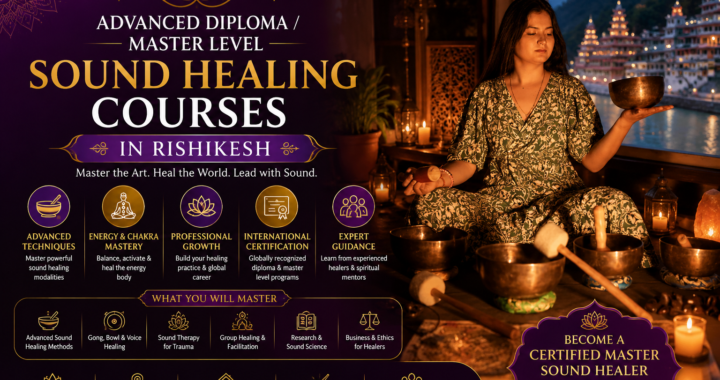

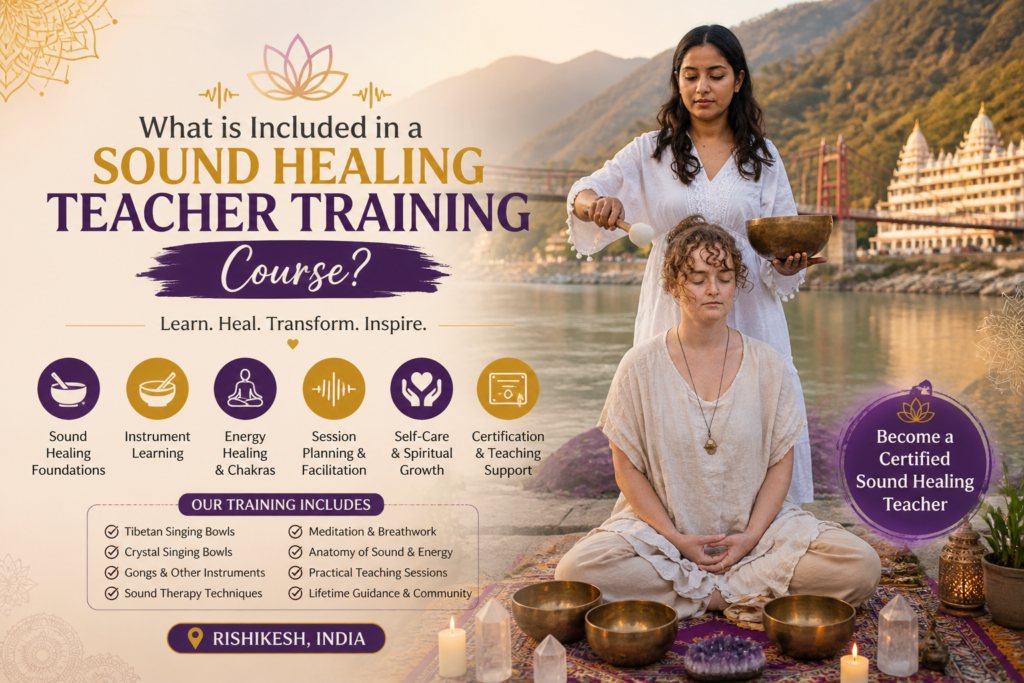
The Ultimate Guide to Sound Healing Teacher Training Course: Curriculum, Science, and Mastery
As the wellness industry shifts toward subtle-body therapies, Sound Healing Teacher Training Course has become one of the most sought-after certifications for yoga teachers, therapists, and holistic seekers. But what exactly goes into a professional-grade course?
Whether you are looking for a Sound Healing Course in Rishikesh or a local certification, a comprehensive curriculum must bridge the gap between ancient Vedic wisdom and modern acoustic physics. Below is a deep dive into the essential modules included in a high-caliber Sound Healing Teacher Training Course program.
1. The Foundations of Sound Science & Acoustic Physics
A professional Sound Healing Teacher Training Course begins by demystifying how sound actually interacts with matter. You cannot effectively heal with sound without understanding the “why” behind the “how.” Key topics include:
- The Principle of Entrainment: Learning how a stronger external frequency (the bowl) can synchronize a weaker internal frequency (the human body).
- Brainwave States: Understanding the transition from Beta (active) to Alpha (relaxed), Theta (dreamlike), and Delta (healing/deep sleep) during a session.
- Resonance and Dissonance: How to use specific intervals to either stimulate the nervous system or ground it.
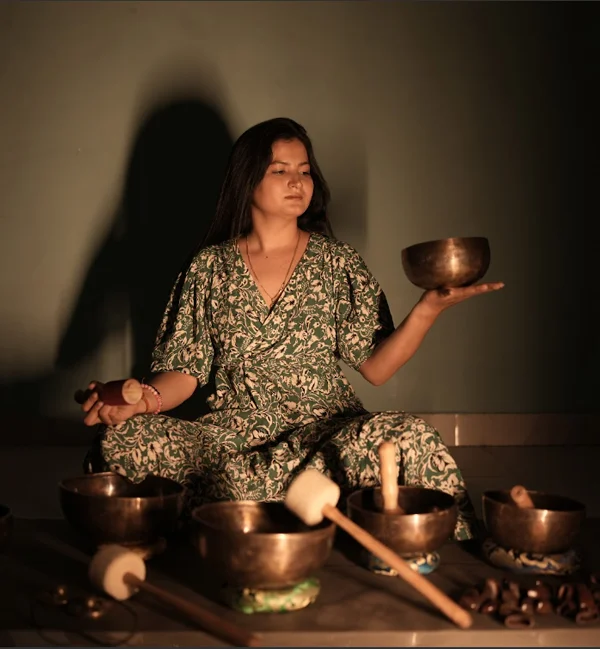
2. Mastery of Himalayan (Tibetan) Singing Bowls
The backbone of most training programs is the singing bowl. However, a Sound Healing Certification in Rishikesh goes beyond just “ringing” a bowl. Students learn:
- Metal Composition: The significance of multi-metal, hand-hammered bowls versus machine-made alternatives.
- Striking & Rimming Techniques: Developing the “soft touch” required to produce pure overtones without harsh surface noise.
- Water Charging: Using vibrations to energize water, a physical demonstration of sound’s power over matter.
3. Anatomy of the Energetic Body (Chakras & Nadis)
Sound Healing Teacher Training Course is often referred to as “vibrational acupuncture.” Training programs typically include a heavy emphasis on:
- The 7 Major Chakras: Assigning specific musical notes (C, D, E, F, G, A, B) to each energy center.
- Clearing Nadis: Using sound to remove blockages in the energy channels that flow through the physical body.
- Aura Scanning: Learning to use a bowl or tuning fork to detect “heavy” or “cold” spots in a client’s energetic field.
4. Advanced Instruments: Gongs, Tuning Forks, and More
While bowls are the foundation, a master practitioner must be a multi-instrumentalist. A robust course, such as the Himalayan Sound Healing Training, will include:
- Gong Mastery: Learning the “white noise” effect of planet-tuned gongs and how to manage the intense emotional releases they can trigger.
- Tuning Forks: Precision tools used for “point therapy” on specific joints or meridians.
- Crystal Bowls: Understanding the high-frequency, airy resonance of quartz crystal and its effect on the upper chakras.
5. The Art of the Individual “Sound Massage”
One of the most technical parts of a 7-day Sound Healing Course is learning how to perform one-on-one sessions. This involves:
- On-Body Placement: Safely placing bowls on the sternum, back, or feet to allow vibrations to travel through the bone marrow.
- Sequence Design: Crafting a 60-minute journey that moves from grounding to clearing and back to integration.
- Contraindications: Learning when not to use Sound (e.g., during pregnancy, for those with pacemakers, or severe epilepsy).
6. Facilitating Group Sound Baths
Leading a group of 20 people is vastly different from a private session. Training modules cover:
- Vibrational Landscapes: How to layer different instruments to create an immersive, 3D sound experience.
- Holding Space: The psychological aspect of managing a room full of people who may be undergoing intense emotional processing.
- Acoustic Setup: Positioning instruments to ensure every participant receives equal vibrational input.
7. The Business and Ethics of Sound Healing
To graduate as a professional, you need to know how to turn your passion into a career. SEO-focused training often includes:
- Marketing Your Practice: How to describe the benefits of Sound Therapy in Rishikesh to a modern audience.
- Ethical Conduct: The importance of professional boundaries and the “healer’s ego.”
- Certification Requirements: Completing case studies and practical exams to earn a recognized certificate.

Why Train in Rishikesh?
While online Sound Healing Teacher Training Course exist, there is no substitute for the Best Sound Healing School in Rishikesh. The natural resonance of the Himalayas and the proximity to the Ganga provide a “sacred sound chamber” that amplifies your own learning and sensitivity.
Ready to Start Your Journey?
If you are looking for an Affordable Sound Healing Training, focus on programs that prioritize practical hours over theory. The more time you spend with the instruments, the more your own frequency begins to harmonize with the healing power of sound.
Explore More: Check out the full syllabus at Satman Sound Healing Rishikesh and take the first step toward becoming a certified vibrational therapist.